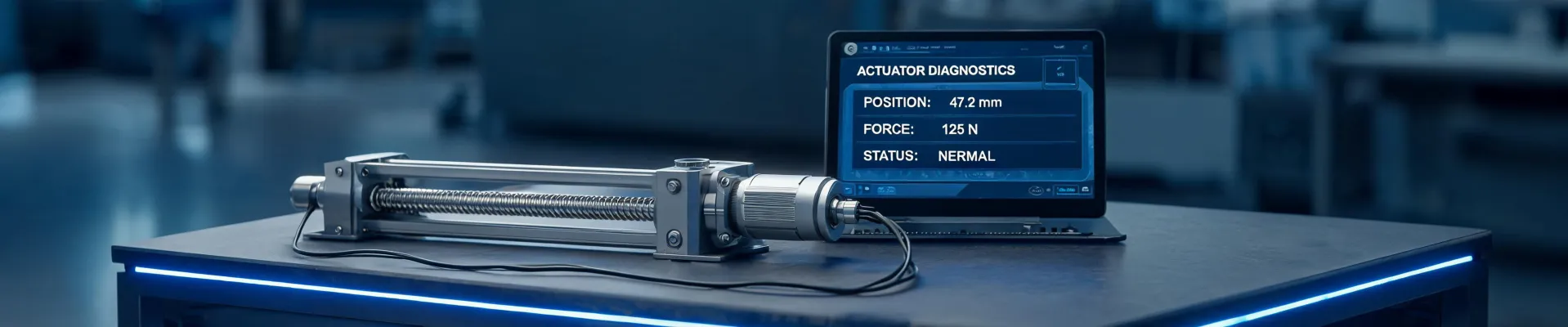
Stop Specifying Components. Order the Validated Total Assembly.
If you are ordering a thomson linear actuator, a ball screw, and a stepper motor as separate line items, you are probably building yourself a headache. I learned this the expensive way last year: a $3,200 order of what I thought were perfectly matched parts turned into a $1,100 rework bill, a 2-week production delay, and a very angry customer. The root cause? I saved $200 on a cheaper 'compatible' flexible shaft coupling. That $200 ‘savings’ cost us nearly half the original order value.
My Particular Brand of Stupid (a.k.a. The Trigger Event)
I didn't fully understand the value of a fully validated actuator assembly until the vendor failure in March 2024. We were retrofitting a pick-and-place system for a packaging line. The spec was straightforward: a thomson linear motion optimized system using a specific stepper motor and a ball screw.
I found a great price on a Fanuc servo motor (surprise, they were over-specced for our need, but the price was right!) and paired it with a standard ball screw. I figured a generic flexible shaft coupling would bridge the gap. I checked the torque, I checked the shaft diameters. On paper, it worked perfectly.
The moment of truth: we powered it on. The motor hummed beautifully. The screw turned. But at just 30% of the rated speed, we got resonance. It wasn't a failure, it was a shudder. We tried tuning the driver. We added a damper. Nothing worked. We eventually realized the mis-spec of the coupling's torsional stiffness created a harmonic that the motor's control loop couldn’t handle.
Result? $780 in rush re-engineering fees, $320 for a proper matched coupling, and 2 weeks of downtime. The customer didn't care that the 'parts were compatible'. They wanted a system that worked. And they were right.
Why 'Compatibility' is a Trap
The most frustrating part of this industry is the illusion that ‘DIY is cheaper’. You think you’re saving money by mixing a Fanuc servo motor with a random ball screw via a cheap coupling. Why do rush fees exist? Because unpredictable demand is expensive to accommodate. You're essentially creating a custom prototype, but paying for it with standard production expectations.
The question isn't 'Do these parts fit?' It's 'Has this specific combination been proven to work?' Here is what most engineers miss about the 'total cost of thinking':
- Time is the biggest hidden cost. I spent 4 hours trying to tune out the resonance. That's 4 hours I could have spent on billable design work (which we lost).
- Risk is a cost. We had to ship the wrong coupling back via overnight freight. The cost of the delay to our client was more than the cost of the part.
- Reputation is a cost. We looked incompetent. I had to stand in front of the client and explain why my 'optimized' system didn't work.
The $500 quote turned into $1,100 after shipping, setup, and revision fees. The $650 all-inclusive quote from Thompson for the validated actuator was actually cheaper. I now calculate TCO before comparing any vendor quotes. It forced me to look at the true cost of engineering time, debugging, and the potential for failure.
The Framework I Now Use (My Pre-Check List)
Since that mistake (circa March 2024), I’ve implemented a simple 3-step check for any motion control order.
- Step 1: Ask the vendor for the 'married' part number. If I want a stepper motor, a ball screw, and a bearing block, I don't just ask for three part numbers. I ask for the assembly part number. Thomson has pre-defined, validated sets. This takes the guesswork out.
- Step 2: Demand the test data. If they claim 'optimized engineering', ask for the test report. What was the resonance frequency? What was the load vs. life curve? If they can't provide it, it's not a system—it's a box of parts.
- Step 3: Run the TCO calculation on paper.
'Standard print resolution requirements: You need to be very careful with the specs. For a motion control system, the 'resolution' of the engineering data is critical. A generic catalog number is 72 DPI. A validated assembly spec is 300 DPI.'
write the total estimated hours of integration and debugging time (a conservative number: 8 hours) at your shop rate ($150/hour). Add that to the sticker price. That is the true cost.
The worst part? I knew this. I've read the white papers. I've seen the charts. But like most beginners, I thought I was smarter than the engineering team (or the sales engineer) who validated that assembly. I thought I could save a buck. I was wrong.
Granted, this requires more upfront work. It means calling a sales engineer (which, honestly, felt excessive when I was busy). But that 15-minute call would have saved me $1,100 and two weeks of my life.
When This Advice Does NOT Apply
To be fair, there are valid reasons to buy components separately. If you are a very high-volume manufacturer with your own in-house R&D and vibration analysis equipment? Go ahead. If you have a machine that has been running for 20 years and you just need a direct replacement? Buy the parts.
But if you are an integrator, a machine builder, or a maintenance manager trying to build something new or optimize a system? Don't be the hero. Buy the validated total assembly. The $200 you save on the coupling isn't worth the $1,100 mistake you'll make fixing it.
Period.