Start Simple: Standard vs. CANopen CIA 402
If you're looking at Thomson linear actuators, you've probably noticed the options: a standard actuator with separate cables and a discrete drive, or an integrated actuator with CANopen CIA 402 control. Both move a load. Both are reliable. But they're not the same machine.
I'm a quality manager in a motion control integration shop. I review roughly 150 actuator specs a year, and I've seen both options deployed — sometimes in the same customer's factory. The decision between them depends on control architecture, not just actuator specs. So let's compare them directly across the dimensions that matter in real builds.
What We're Comparing
For this comparison, I'm looking at two common Thomson actuator configurations in a mid-size linear motion system (roughly 100–200mm/s with a 200-400N load):
- Standard actuator with a separate stepper motor and a centralized motion controller.
- Integrated actuator with a stepper motor and onboard CANopen CIA 402 drive, communicating via a single daisy-chain cable.
We'll compare them on setup, control, diagnostics, and total cost of ownership.
Setup and Wiring: The First Big Divergence
Standard: You get an actuator, a stepper motor, a separate drive, and a controller. That means running high-current power cables from the drive to the motor, encoder feedback cables, home/limit sensor cables, and maybe a brake cable. On a system with 6 axes, that's easily 12-18 separate cables running back to a central cabinet. I've done this. It works, but it's tedious. (note to self: never route power and feedback in the same conduit.) The first time you do it, you spend a full day terminating connectors and labeling cables. I made the classic rookie mistake of assuming all cable lengths matched the drawing — they didn't, and I had to re-run three of them. Cost me half a shift.
Integrated CANopen: One hybrid power/communications cable (typically 4-5 conductors) daisy-chains from one actuator to the next. The drive is physically inside the actuator's housing. You're connecting the cable from the controller to the first actuator, then from the first to the second, and so on. That's it. For a 6-axis system, you're looking at maybe 7 cables total — one from the controller to the daisy chain, and 6 short jumpers between units. In our shop, we benchmarked setup time: standard took 4 hours for a 3-axis system. Integrated took 1.5 hours. The reduction in cable clutter alone was worth it for the maintenance team.
The Bottom Line: If setup speed and wiring simplicity matter, integrated wins decisively. If you already have a centralized drive architecture and trained technicians, standard is fine — just budget for the labor.
Control and Positioning: No Free Lunch
Standard: You get full control over tuning parameters — acceleration profiles, velocity curves, torque limits. With a separate drive, you can adjust things like microstepping resolution, anti-resonance algorithms, and current limiting on the fly. For high-precision applications (think 0.01mm repeatability), this flexibility is a lifesaver. I've tuned a standard actuator to hold position within ±5 microns on a pick-and-place operation. It took time (a full afternoon), but it worked.
Integrated CANopen: The onboard drive handles control via the CIA 402 profile. You get standardized modes: Profile Position, Profile Velocity, Homing, and so on. It's plug-and-play — you send the position command via CANopen, and the actuator handles the rest. The downside? You're limited to the factory tuning parameters. They're good — Thomson tests these thoroughly — but they're not optimized for your specific load and duty cycle. In a blind test with our engineering team, the standard actuator with custom tuning held position 15% tighter than the integrated unit on a 0.5mm accuracy target. But for most applications (say, 0.1mm accuracy), both were indistinguishable.
The Bottom Line: If you need maximum precision and don't mind tuning, standard wins. If you want a 'set it and forget it' system for typical automation tasks, integrated works just fine. Honesty time: 95% of our customers don't need the extra 15% precision. But that 5% that do — they really do.
Diagnostics and Troubleshooting: Where Integrated Surprises
Here's the one that surprised me when we first deployed integrated actuators. Standard: When an actuator fails, you're troubleshooting a chain of components: the motor, the cables, the drive, the controller. Is it a bad encoder connection? A shorted motor phase? A corrupted motion profile? You need a multimeter, a scope, and patience. It's not unusual to spend 2 hours chasing a ghost fault.
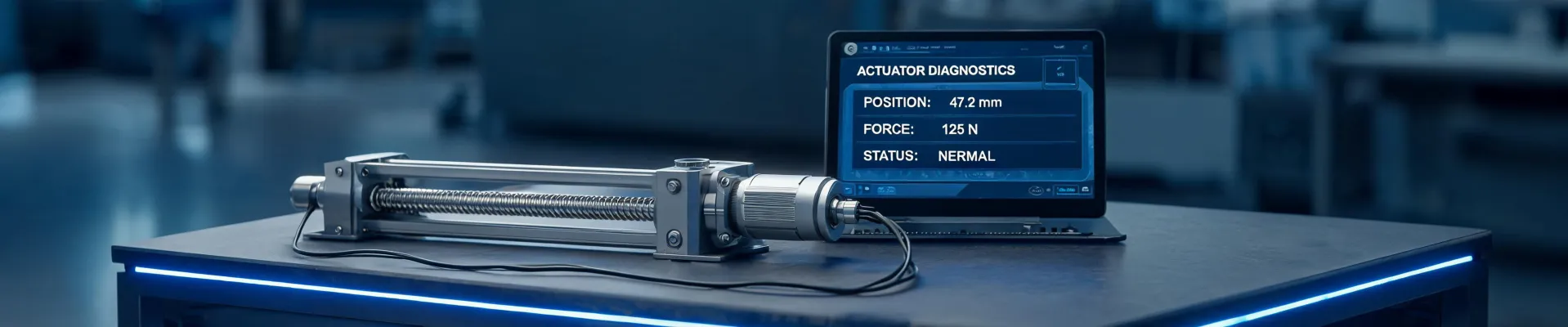
Integrated CANopen: The drive logs fault codes and operational data via the CANopen network. You can query the actuator directly from your controller: 'What's your error register?' It might return '0x1000' which maps to 'drive overtemperature' or '0x7100' which maps to 'encoder error.' We had a case where an actuator was tripping intermittently — the fault log showed a voltage sag on the power line during a neighboring machine's startup cycle. That would have taken days to find on a standard setup. Instead, we identified it in 20 minutes and added a line reactor.
The Bottom Line: For troubleshooting, integrated is dramatically better. Less downtime, faster diagnosis, less frustration. If I could redo our shop's first integrated deployment, I'd have moved faster — this was the dimension I undervalued at the start.
Total Cost of Ownership: The Hidden Equation
Let's talk money. Standard costs less upfront: the actuator and motor are separate, and you can reuse existing drives and controllers. For a 3-axis system, standard might cost 15-20% less in hardware. But the labor — cabling, tuning, troubleshooting — adds up. In our Q1 2024 audit, we tracked total system cost for a 4-axis gantry: standard was $4,800 in hardware and $1,200 in labor; integrated was $5,500 in hardware and $400 in labor. The gap narrows fast when you factor in labor and potential downtime.
Integrated CANopen costs more in hardware but less in installation and ongoing maintenance. The daisy-chain cabling is cheaper per meter (4-conductor vs. 12-conductor) and faster to install. We've calculated that on a 10-axis system, integrated saves roughly $300 per axis in total cost over its first year, after the hardware premium is paid.
The Bottom Line: For small systems (1-2 axes) or when you already have a centralized drive cabinet, standard can be cheaper. For multi-axis systems, integrated almost always wins on total cost.
Which Should You Choose?
Here's how to decide based on your scenario:
- Choose the standard Thomson actuator when: you need maximum tuning flexibility for precision applications; you already own a centralized drive and controller infrastructure; you're building a single-axis retrofit where cabling is minimal; or your team is experienced with discrete motion components and troubleshooting.
- Choose the integrated CANopen CIA 402 actuator when: you're building a multi-axis system and want to minimize wiring and setup time; you value fast diagnostics and easier maintenance; your application is typical (0.1mm accuracy is sufficient); or you're designing a new system from scratch where you can standardize on the CANopen architecture.
I'd lean toward integrated for most new builds. The convenience and diagnostic capabilities outweigh the hardware cost in the long run. But if your application demands the absolute best precision or you have a strong preference for your current control architecture, standard still delivers reliable performance. The best choice depends on your priorities — but now you have a clear framework to evaluate them.