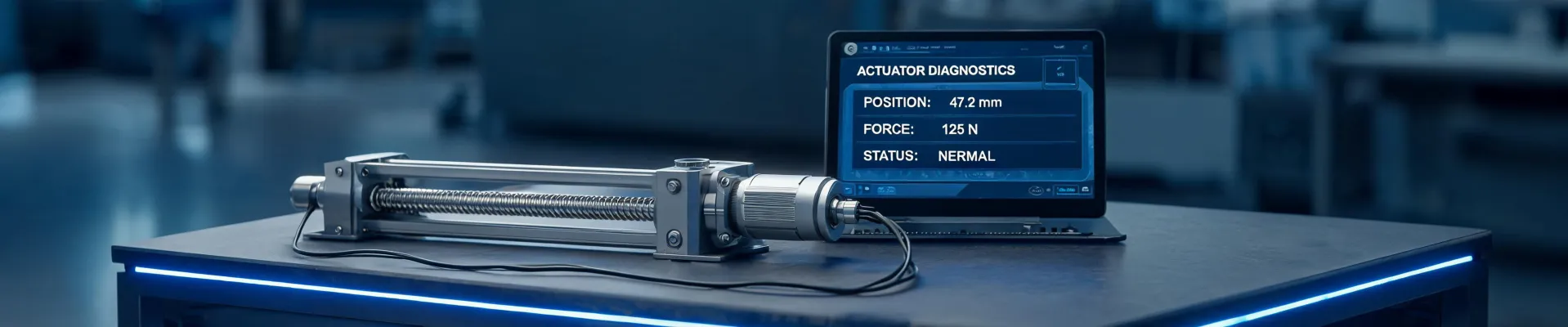
Your actuator died again. Third one this year on the same machine. You budget for it, tell yourself it's a wear item, and move on.
I've been a procurement manager in the automation space for seven years. I manage roughly $700,000 a year in motion components across industrial equipment. I've negotiated with 40+ vendors, tracked every invoice, and documented every single actuator failure we've had—every one—since 2019. That habit has saved us approximately $85,000.
Here's what I want to walk you through: why your actuator keeps failing, what it's actually costing you (and I don't just mean the invoice price), and what I wish I'd understood five years earlier.
The Surface Problem: "Actuators Are Just Wear Items"
Most engineers I've worked with shrug off actuator failures as normal wear. "They're mechanical. They wear out. You replace them." And that's partly true.
But nobody stops to ask: why is it failing so fast? Four months of service on an actuator designed for a two-year life isn't wear. It's a failure.
When I started analyzing our replacement data, I found something uncomfortable. We weren't buying a bad brand. We were buying actuators with the wrong specifications for the application. Every single time.
The Deep Causes: What I Actually Found in the Data
Deep Cause #1: Voltage Was Our Only Spec
I'm a little embarrassed about this in hindsight. When we first ordered replacement 12V actuators, the maintenance team would literally search for "thomson linear actuator 12v" and pick the cheapest listing that showed up. Stroke length? We'd guess. Load capacity? We'd check the static limit. Duty cycle?
We didn't check duty cycle at all. That was the single biggest mistake.
Duty cycle is how long the motor can run before it needs to cool down. An actuator rated for a 25% duty cycle at 100 kg can handle 25 kg continuously. But we were running it at 50 kg, continuously, 47 minutes out of every hour.
The math: 25% duty means 15 seconds running, 45 seconds resting. We were running it for minutes at a time. The motor kept overheating, thermal protection never properly kicked in on those cheaper units, and the internal plastic gear stripped. Every time.
Here's the part that took me way too long to grasp: the "cheap" actuator wasn't a cheap version of the same thing. It was a different thing entirely.
Deep Cause #2: Dynamic Load vs. Static Load
This one still trips people up. And honestly, most catalogs don't make it easy.
An actuator's static load rating might say 500 kg. That's how much force it can hold without breaking. The dynamic load rating might be 100 kg. That's how much it can actually move on a regular basis without destroying itself.
We had an application where the actuator was pushing 150 kg. Under the static rating. Over the dynamic. Every cycle.
It failed. Of course it failed. We blamed the manufacturer. But after auditing the spec sheet—and talking with an applications engineer—it turned out the actuator was undersized by 50% for the actual job. Not bad building. Bad buying.
According to IEC 60034-1, electric motor duty types are explicitly classified (S1–S10) so that purchasers can match equipment to real operating conditions. Very few buyers actually use those classifications when ordering. We weren't one of them, at least not then.
Deep Cause #3: The "Compatible" Component Trap
This pattern isn't unique to actuators. I see it across the board.
People search for "mg995 servo motor" or "deep groove ball bearings" and buy whatever's cheapest. They assume identical specs mean identical performance.
A servo motor isn't just a servo motor. The mg995 is a good example. The spec sheet claims 13 kg-cm of torque. Independent torque tests—people have compared them on rigs and posted the results—show some off-brand units deliver barely 60-70% of that under load. If your application has a 10% functional margin, you're going to fail.
With deep groove ball bearings, I've seen off-brand lots where noise and runout varied by as much as 40% between batches from the same maker. That's not a quality product—it's gambling with a part number.
That's the trap. The "same spec" trap.
Deep Cause #4: The Wrong Question About Speed
Here's a question I hear constantly from our internal team: "how fast can a stepper motor turn?"
It's the wrong question. The right question is: "how fast can a stepper motor turn and still deliver enough torque for this load?"
A typical 200-step stepper motor, depending on the driver and supply voltage, can spin at 1000+ RPM unloaded. But torque falls off a cliff as speed rises. At 800 RPM, you're often down to 20% of holding torque. The direct answer to "how fast can a stepper motor turn" is almost always "faster than is useful."
I've made this exact mistake. I once ordered 30 stepper motors based on the holding torque spec because the vendor didn't publish a torque-speed curve. Our machine stalled at running speed. We burned $1,400 in trial-and-error before finding a vendor who'd actually show us the curve.
We paid $1,400 to learn what a spec sheet would've told us for free.
The Real Cost of Getting It Wrong
Let me put real numbers on this from our 2023 audit. This was one packaging line:
- Replacement actuators: $140 × 18 replacements = $2,520
- Overnight shipping on rush replacements: $90 × 12 = $1,080
- Maintenance labor: 4 hours × $85/hr × 12 incidents = $4,080
- Production downtime: 3 hours × $450/hr × 12 incidents = $16,200
- Tooling and modification work: $2,600
Total: $26,480.
On what we initially thought was a $2,500 problem.
That "free setup" and low price came with hidden fees I never saw coming. And this was one machine. We have seventeen.
The secondary damage is the sneaky part. When an actuator fails mid-process, it doesn't just stop. It can damage the screw shaft, the guide rails, even the product being moved. I've personally seen a $140 actuator failure cause $3,000 in collateral damage to the machine frame. Those costs never get allocated back to the actuator.
Once I ran the TCO numbers, switching vendors was a no-brainer. We moved to a properly spec'd thomson saginaw linear actuator at $430 each, with a published 50% duty cycle, a 25% dynamic load margin, and real testing documentation. Fourteen months later, we've replaced exactly one unit. That's a 90% reduction in failure-related costs.
Why This Matters for Your Budget
Here's the formula I use now, after tracking 200+ orders across six years of failure data:
Total cost of component ownership = (purchase price × number of replacements over the equipment's life) + (labor × hours per replacement) + downtime cost + expedited shipping + cost of secondary damage.
Most purchasing decisions only look at the first term. Sometimes the first two. That's like buying a car and ignoring fuel and insurance costs for the next decade.
My experience is based on industrial robots and packaging lines in a mid-sized automation company. If you're working on a one-off prototype with minimal operating hours, your decision might look different. The principles hold, but the urgency changes.
What I'd Recommend Instead
If your actuators keep dying, don't start by switching brands. Start by answering four questions:
- What's the actual dynamic load? Not the static load. The moving, cycling, working load.
- What's the duty cycle of your application? How many seconds of motion, followed by how many seconds of rest?
- What are the real environmental conditions? Dust, moisture, temperature swings all impact actuator life.
- What does one failure actually cost? Include downtime. Include collateral damage. Include the overtime.
Then, take those answers to a manufacturer's applications engineer. Not a distributor who just takes orders—someone who'll ask you hard questions.
I'll say this: when we talked to Thomson's engineering team about our most critical packaging line, they spotted that we were undersizing every actuator by roughly 50%. That conversation saved us about $18,000 in the first year alone.
A Quick Note on Process (and Getting Burned)
We didn't have a formal replacement evaluation process until the third identical actuator failure in one quarter forced me to build one. Now, every replacement goes through a review: has this failure happened before? What's the role of this component? Did we spec it correctly?
The third time we ordered the wrong quantity, I finally created a verification checklist. Should've done it after the first time.
If you're nodding along because this has happened to you, start the process today. Don't wait for the next failure to force your hand. An hour of spec review costs you maybe $100. The wrong actuator costs you $1,400.
I wish someone had shown me this math six years ago.
Prices referenced are from our 2024 procurement records and are approximate. Actual pricing varies by vendor, volume, and config. Verify current rates before making a decision.